
The FSB conducted an experiment on Sverdlovsk residents, posing as recruiters.
The FSB conducted an experiment on residents of Sverdlovsk Oblast by posing as recruiters
30 November 2025
The Antiterrorism Commission of Sverdlovsk Oblast carried out a unique experiment simulating the recruitment of the region’s residents. The project, which the body calls unprecedented, was aimed at studying methods of drawing citizens into unlawful activity by offering “easy” money.
The initiative was implemented by the online publication Inburg.ru with the support of the regional FSB directorate.
From 19 to 26 November 2025, the region’s media space was used to create a simulation of recruiters’ activity: ads styled as offers of quick and anonymous earnings were circulated. These publications served as a starting point for directing people to a specialized chat-bot that step-by-step engaged users in scenarios of potentially unlawful activity — from fictitious courier deliveries to proposals to destabilize and put city infrastructure objects out of service, reports the Telegram channel “Antiterror Ural.”
“Statistical data collected during the experiment proved to be very telling. The total number of views of the mock advertisements reached 28,800. Of these, 176 people showed initial interest and moved into the chat-bot for further interaction. Ten users reached the final stage, expressing a willingness to participate in the proposed unlawful scenarios,” the organizers of the experiment said.
“In order to carry out further preventive work and ensure public safety, information about all persons who expressed a willingness to engage in illegal activity has been passed to law enforcement agencies for appropriate measures,” the authors concluded.
In turn, Inburg.ru said that before the start of the experiment it published social videos about the activities of criminal groups and foreign intelligence services. Then, after several publications, “recruiters’” ads were posted in the same groups. Their texts were based on real spam comments of this kind.
The bot called Anonymous work at the first stage immediately hinted that the activity would be outside the law.
“If the user pressed [No], the bot replied ‘Correct answer’ and sent a social video with a message from the representative of the FSB of Russia’s Sverdlovsk Oblast directorate, Elena Dokuchaeva. This video was shown in any case at the end. If the user pressed [Yes], a second stage began. One of two ‘work directions’ was offered:
1. Courier delivery. You need to carry a small packaged item from point A to point B. ‘No risk,’ up to 350,000 rubles per month.
2. Technical interference. Approach a city infrastructure object and ‘put it out of service.’ ‘More difficult, more dangerous, but more lucrative’ — up to 2 million rubles for 15 minutes,” the publication that cooperated with the antiterrorism commission writes.
The bot emphasized anonymity, no in-person meetings, and payment in cryptocurrency. If the user chose “I changed my mind,” the final video was also sent. When choosing any other option the bot replied that further instructions would come later and asked again whether the user was willing to continue.
When answering [No] the bot again said “Correct answer!” If the user pressed [Yes], the bot reported: “You have just agreed to terms that in real life could lead to a criminal case and real prison terms.”
Seen a typo? Highlight the fragment and press Ctrl+Enter
What’s being discussed
Uralweb.ru on social networks
Другие Новости Екатеринбурга (ЕКБ166)
 A resident of Artemovsky was punished for drifting near the Karnaval shopping center in Yekaterinburg.
The State Traffic Inspectorate of the Ministry of Internal Affairs of Russia for Yekaterinburg identified the driver who performed a drift near a pedestrian zone at a shopping center. A video capturing a serious violation of traffic rules appeared online on November 25.
A resident of Artemovsky was punished for drifting near the Karnaval shopping center in Yekaterinburg.
The State Traffic Inspectorate of the Ministry of Internal Affairs of Russia for Yekaterinburg identified the driver who performed a drift near a pedestrian zone at a shopping center. A video capturing a serious violation of traffic rules appeared online on November 25.
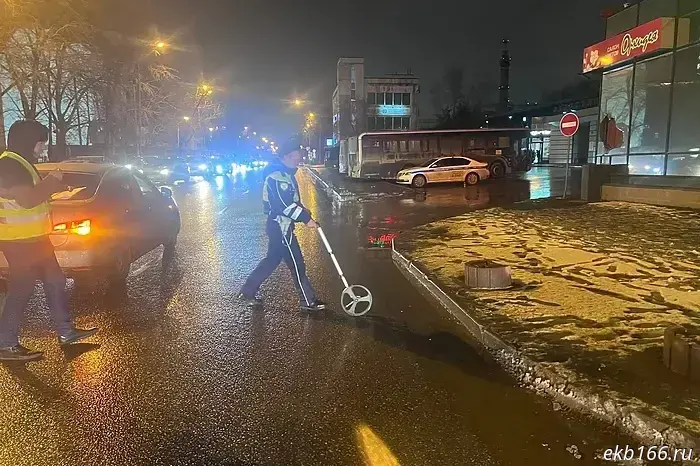 In Yekaterinburg, a Nissan fatally struck a woman on Vostochnaya Street.
In Yekaterinburg, a Nissan fatally struck a woman on Vostochnaya Street.
In Yekaterinburg, a Nissan fatally struck a woman on Vostochnaya Street.
 The outgoing year 2025 may be the warmest in the entire history of meteorological observations in Yekaterinburg.
The outgoing year 2025 has every chance of becoming the warmest year on record in Yekaterinburg. This was stated by meteorologist Alexey Pulin on his Telegram channel "Weather in Yekaterinburg."
The outgoing year 2025 may be the warmest in the entire history of meteorological observations in Yekaterinburg.
The outgoing year 2025 has every chance of becoming the warmest year on record in Yekaterinburg. This was stated by meteorologist Alexey Pulin on his Telegram channel "Weather in Yekaterinburg."
 In the Khanty-Mansi Autonomous Okrug, the name Anna became the most popular among newborn girls, overtaking Amina.
In November the most popular name among newborn boys in the Khanty-Mansi Autonomous Okrug–Yugra was Muhammad, and among girls it was Anna. A month earlier the leading name was Amina, reports URA.RU, citing the regional registry office portal.
In the Khanty-Mansi Autonomous Okrug, the name Anna became the most popular among newborn girls, overtaking Amina.
In November the most popular name among newborn boys in the Khanty-Mansi Autonomous Okrug–Yugra was Muhammad, and among girls it was Anna. A month earlier the leading name was Amina, reports URA.RU, citing the regional registry office portal.
The FSB conducted an experiment on Sverdlovsk residents, posing as recruiters.
The Anti-Terrorism Commission of the Sverdlovsk Region conducted a unique experiment simulating the recruitment of the region's residents. The project, which the agency calls unprecedented, was aimed at studying methods of drawing citizens into illegal activities by offering "easy" money.